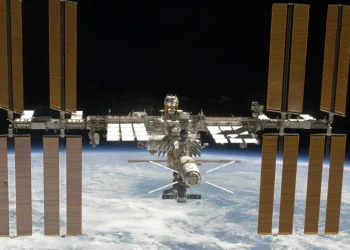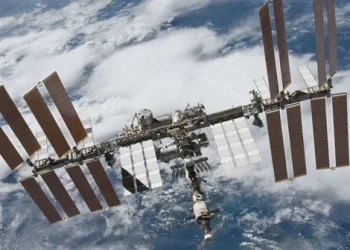


With a space station medical evacuation safely completed, NASA is focused on two challenging missions running in parallel: launching four astronauts for a flight around the Moon, at the same time as the agency plans to send four replacement astronauts to the International Space Station.
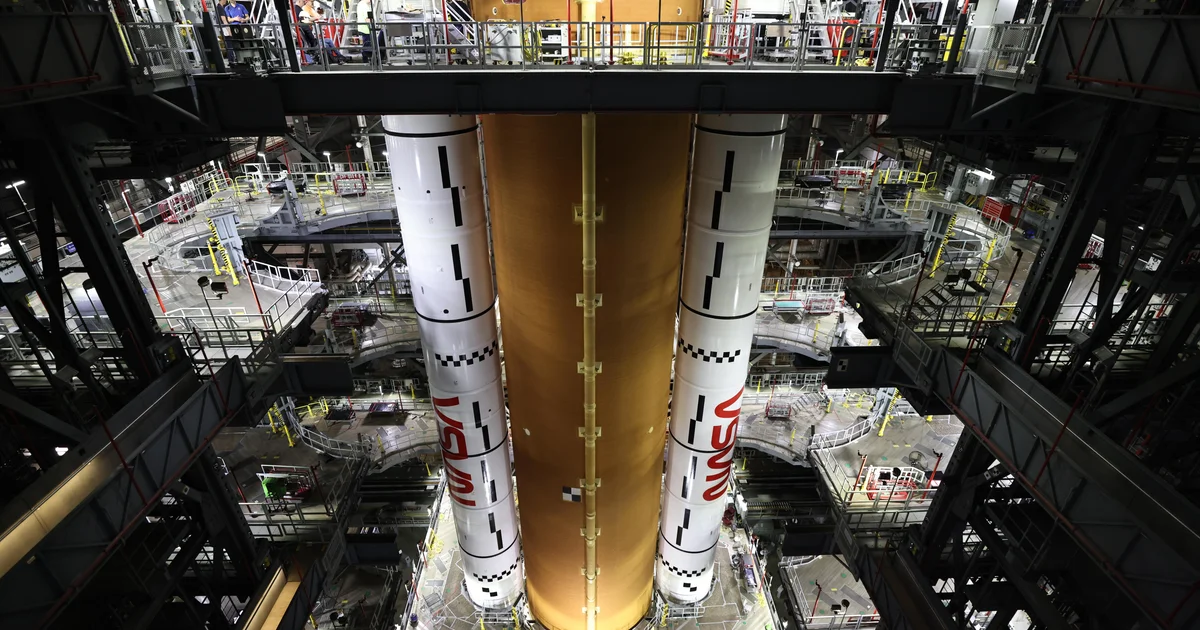
Engineers plan to transport the Artemis 2 moon rocket to Launch Pad 39B at the Kennedy Space Center on Saturday for testing leading up to launch early next month for a historic piloted flight around the moon.
NASA/Keegan Barbier 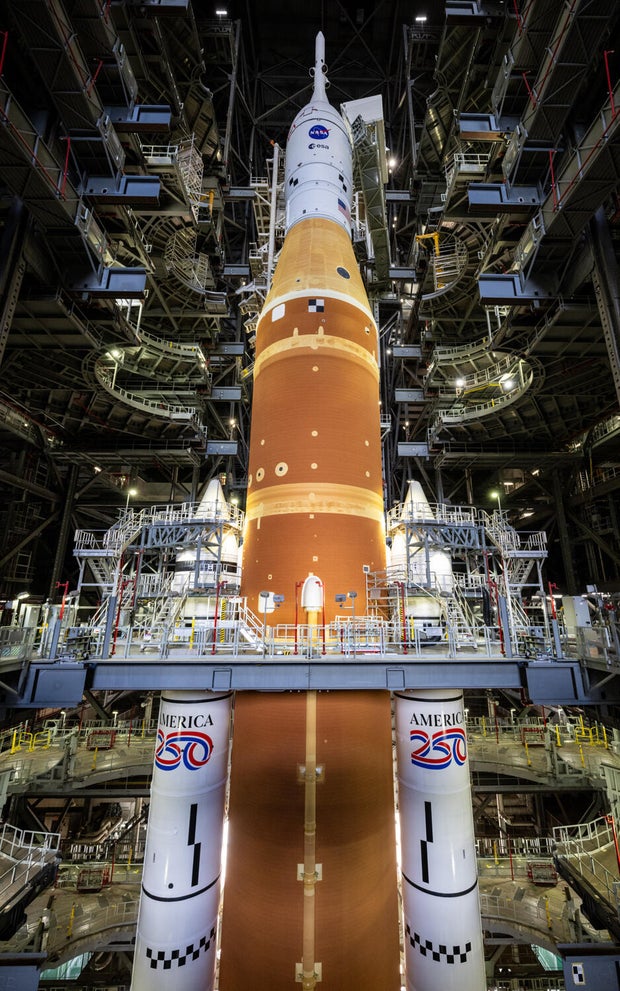
At the same time, NASA is preparing to launch four Crew 12 astronauts to the space station, perhaps while the Artemis 2 lunar mission is underway, to replace four Crew 11 crew members who cut their mission short and returned to Earth earlier than planned Thursday due to a medical issue.
The Artemis 2 mission and Crew 12’s planned flight to the space station present a unique challenge for NASA. The agency has not managed two spacecraft piloted at the same time since a pair of two-man Gemini capsules tested rendezvous procedures in low Earth orbit in 1965. The agency has never flown a deep space mission in the middle of another Earth orbit launch.
“This is exactly what we should be doing at NASA,” Jared Isaacman, NASA’s new administrator, said Thursday. “We have the means as an agency… to be able to bring our astronauts home at any time… while preparing for our next mission, like Crew 12, while making progress on our Artemis 2 campaign.”
He described the lunar mission as “probably one of the most important human spaceflight missions of the last half century.”
The most powerful rocket booster in the world
NASA’s massive 322-foot-tall Space Launch System rocket, the world’s most powerful operational booster, will be carried out of the cavernous Vehicle Assembly Building early Saturday atop an upgraded Apollo-era tracked transporter. Including at least one stop along the way, the 4-mile trip to the platform should take eight to ten hours.
“It takes us a little while to get out of the building,” said Charlie Blackwell-Thompson, launch director. “But about an hour after you get that first movement, you will start to see this beautiful vehicle cross the threshold of the VAB and come out for the world to see.”
Once on the platform, engineers will perform a variety of tests and work to prepare the rocket and its Orion crew capsule for liftoff early next month on the Artemis 2 lunar mission.
“It really doesn’t get better than this,” John Honeycutt, chairman of the Artemis 2 mission management team, told reporters Friday. “We’re making history.”
Commander Reid Wiseman, Victor Glover, Christina Koch and Canadian astronaut Jeremy Hansen planned to be on hand for the deployment. If all goes well, the crew will test the Orion capsule in Earth orbit before heading into deep space, flying further from home than any other human as it loops around the far side of the Moon.
Artemis 2 mission plan
The Artemis 2 mission follows a similar flight in 2022 that sent an unpiloted Orion capsule around the Moon to pave the way for next month’s flight. The Artemis 2 mission, in turn, will set the stage for Artemis 3, a long-awaited and often-delayed mission aimed at landing astronauts near the Moon’s south pole. The current target date for Artemis 3 is 2028.
Despite the deployment scheduled for Saturday, the launch date of Artemis 2 is still uncertain.
Much will depend on the results of a fueling test around the first of the month, when engineers plan to load the 21-stage booster’s first stage with 733,000 gallons of very cold liquid hydrogen and oxygen as well as a full load of propellants for the booster’s 45-foot-tall second stage, the intermediate cryogenic propulsion stage, or ICPS.
NASA/Frank Michaux 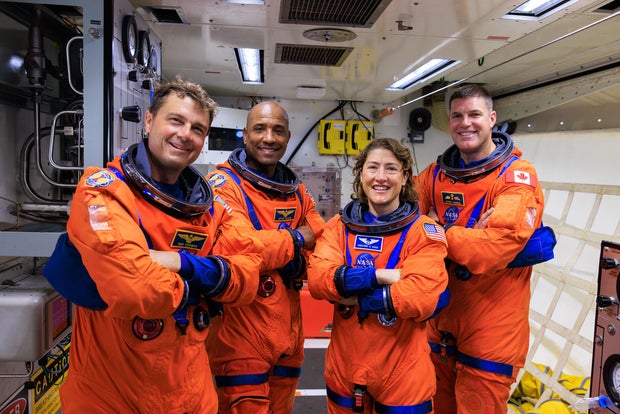
During testing of the SLS rocket used for the Artemis 1 mission in 2022, multiple fueling tests had to be performed before engineers finally resolved a series of propellant leaks. The SLS deployed on Saturday includes several upgrades and improvements to minimize or eliminate such leaks.
If the next refueling test goes well, Wiseman and his teammates could be cleared for takeoff a few days before Feb. 11, the end of next month’s launch period. If major problems are found during the propellant loading exercise, Artemis 2 will likely be delayed until early March, when the next set of launch windows becomes available.
Next space station crew
Amid work preparing for the launch of the Artemis 2 rocket, NASA officials are also working to expedite the crew launch of the Crew 12 space station. Commander Jessica Meir, Jack Hathaway, Sophie Adenot of the European Space Agency and cosmonaut Andrey Fedyaev are officially scheduled to launch on February 15.
The crew they are replacing, Crew 11 Commander Zena Cardman, Mike Fincke, Japanese astronaut Kimiya Yui and cosmonaut Oleg Platonov, were originally scheduled to return to Earth around Feb. 20 after helping their replacements familiarize themselves with the intricacies of operating the space station.
NASA/Bill Ingalls 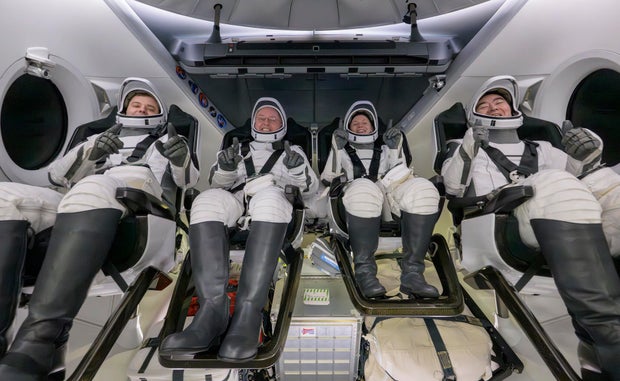
But Crew 11 was ordered to cut their mission short after one of the crew members developed a medical problem. They returned to Earth on Thursday, leaving only three people aboard the space station: cosmonaut Sergey Kud-Sverchkov, Sergey Mikaev and NASA astronaut Chris Williams. They were launched to the outpost in November aboard a Russian Soyuz spacecraft.
NASA and SpaceX are working to advance the launch date of Crew 12 to minimize the gap between the two NASA missions. Depending on where this ends up, NASA could orchestrate a launch to the International Space Station while the Artemis 2 crew flies around the Moon.
“I don’t see any reason why we wouldn’t continue on these parallel paths,” Isaacman said. “And if there comes a time where we need to resolve conflicts between two human spaceflight missions, that’s a very good problem to have at NASA.”
Jeff Radigan, Artemis 2’s senior flight director, agreed that it made sense to continue preparing for both missions.
“I know the agency is getting ready to launch Crew 12,” he told reporters. “There are a lot of preparations going on, but there are absolutely constraints.”
“It’s not prudent for us to present both at the same time, but we also need to make sure they’re both ready to go. We could run into a problem, and the last thing we want to do is make a decision too early and then lose an opportunity. That wouldn’t be responsible on our part.
“So we need to continue to emphasize both missions, we need to make sure we’re doing it at the right speed and looking at the right technical constraints. As we get closer, either the decision will be made because the hardware speaks to us and we have a problem we need to solve, or we need to choose one.”
But, he added, “this does not mean that we should stop preparing one or the other mission right now, but we must do it at the right pace.”
Source | domain www.cbsnews.com