


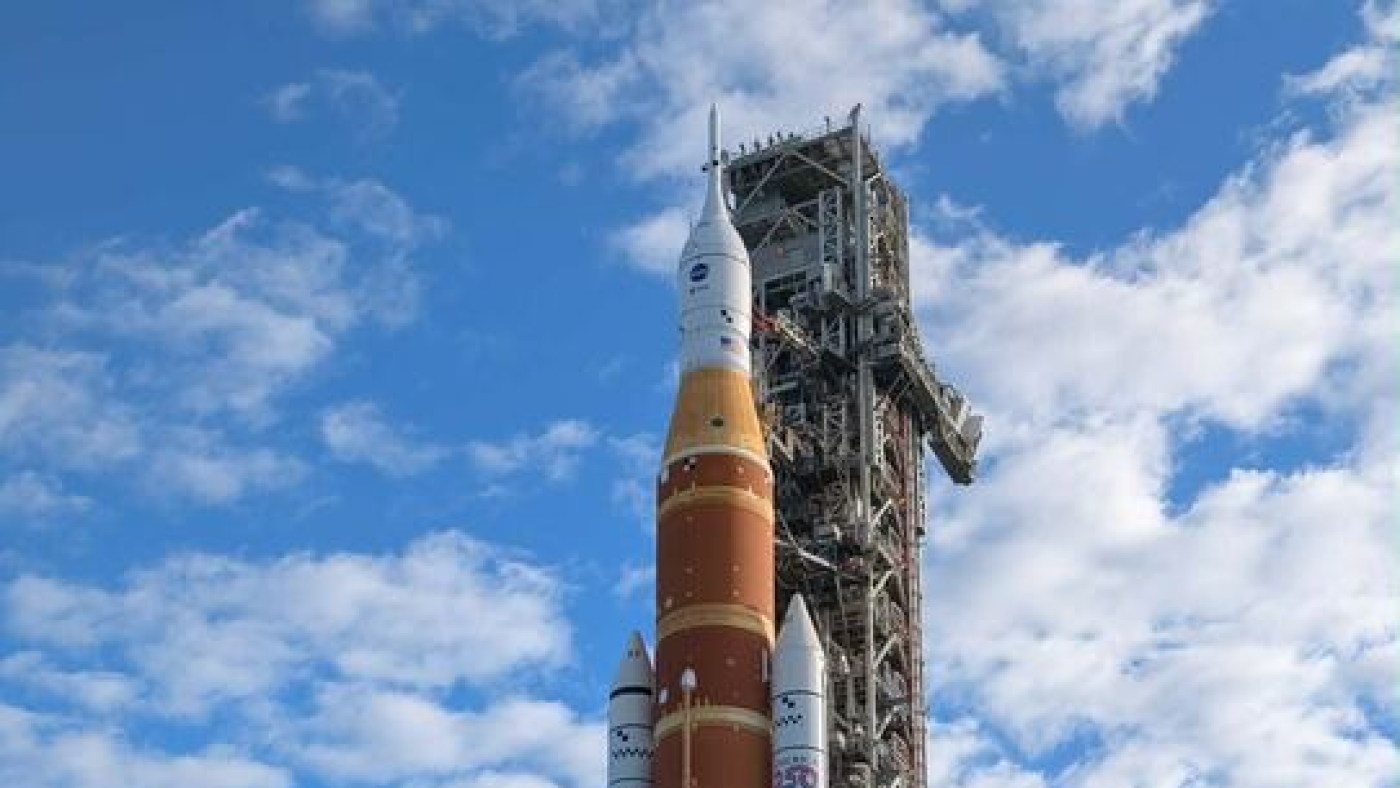

Artemis II will send a crew of four astronauts on a trip around the Moon as the United States prepares to send American astronauts to the Moon for the first time in more than five decades.
Derek Demeter/Central Florida Public Media
hide caption
toggle caption
Derek Demeter/Central Florida Public Media
NASA on Saturday deployed the spacecraft that will take Americans on a journey around the Moon, as part of the agency’s Artemis II mission.
The integrated Space Launch System (SLS) rocket and Orion spacecraft – which will host the four astronauts flying the mission – began their one-hour journey from the Vehicle Assembly Building to Launch Pad 39B around 9 a.m. ET.
The agency said the four-mile journey to transport the 11 million pound rocket could take up to 12 hours.
“The architecture that you see behind us here with SLS and the Orion spacecraft is just the beginning,” NASA Director Jared Isaacman told reporters at the event.

“Over time, launching missions like this, we will learn a lot and the architecture of the vehicle will change. And as it evolves, we should be able to undertake repeatable and affordable missions to and from the Moon.”
The lunar launch could take place as early as February 6, depending on the readiness of the team and the rocket.
The craft’s four astronauts — Christina Koch, Victor Glover, Reid Wiseman and Canadian Space Agency astronaut Jeremy Hansen — will first orbit the Earth before traveling around the Moon. The trip is expected to last approximately 10 days.
The goal of the Artemis program is to ultimately send Americans to the Moon for the first time in more than 50 years, with the longer-term goal of carrying out missions to Mars.
The launch of Artemis II follows the original Artemis launch, which sent an uncrewed craft into space in 2022.
What lunar orbit would teach his scientists on board, Isaacman said, “is what’s going to enable missions like Artemis 100 and beyond,” adding that he hoped the mission would also inspire future generations of astronauts.
“Why are we doing this? We are doing this to keep a promise – a promise to the American people that we will return to the Moon.”
Source | domain www.npr.org