

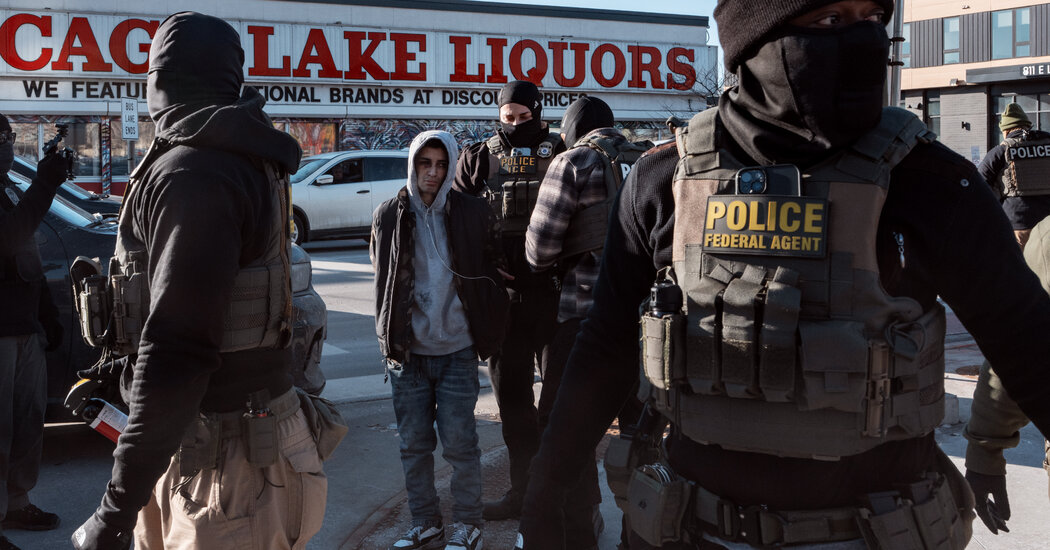
The vehicles all came to a screeching halt – SUVs full of masked immigration agents and cars carrying activists and journalists following them – and in less than a second, everyone was on the frozen Minneapolis street corner, face to face.
Car horns and sirens and whistles from activists almost drowned out the insults hurled at the ICE agents. Men in military-style uniforms got out of an SUV, pointing pepper spray cans at cars. Other federal agents were already surrounding a man in a hoodie who was standing at a bus stop on Lake Street.
Activists rushed to the bus stop, some of them also masked. Whistling, they raised their phones to film a video, trying to alert the entire neighborhood: ICE is here. ICE is there, arresting someone. Curses and pepper spray splashed into the crowd. The officers pinned the man in the back of a car and drove away.
Fear and fury can explode on any street corner during this busy time in Minneapolis, anytime and anywhere the muscle of the federal government meets the rage of citizens who reject its tactics.
Thousands of people participated in a march last Saturday to mourn Renee Good, the woman an ICE agent shot and killed days earlier. There have been walkouts at schools, daily protests outside the federal building where agents take detainees, demonstrations by four people on freezing streets and an hour-long protest after an ICE agent shot a man in the leg while trying to arrest him Wednesday night.
But the city’s challenge to the thousands of federal agents pouring into Minneapolis also looks like this: Residents are using their cars, whistles, phones and local networks to surveil and confront agents wherever they can, standing close to them to complicate their efforts, like cornerbacks guarding receivers.
It’s a game of cat and mouse with a global audience, high stakes and an element of imminent danger. Activists are pushing against a gray area of legality as they try to confront heavily armed federal agents who they accuse of doing far worse.
Most of the protesters are white, but others, including Native Americans, participated. Several white protesters and volunteers said they felt they had a special responsibility to defend neighbors who they believed would be vulnerable to ICE attacks.
These white volunteers also said they were motivated to get involved after Ms. Good’s murder on January 7.
The Trump administration has said an immigration crackdown in Minnesota is necessary to combat widespread fraud in the state, particularly in Minnesota’s Somali community, which President Trump has repeatedly ridiculed and insulted.
Mr. Trump and other federal officials have claimed that the ICE agent who killed Ms. Good acted “in self-defense,” claims that Minnesota officials have rejected. A New York Times analysis of videos of the shooting contradicts the Trump administration’s narrative.
Driving in their own cars in shifts, scanning the streets for vehicles they think are suspicious – often large American-made SUVs with out-of-state license plates – volunteers report their sightings to neighborhood group chats.
Recently, on East Lake Street, a normally busy commercial street, most immigrant-owned businesses were closed: employees and customers were afraid to leave their homes.
Mid-morning, the sound of car horns and whistles interrupted the chilly calm. A dark SUV raced down the street, followed by two activist cars in pursuit. Then another SUV sped in the other direction, pursued by another convoy of activists. Traffic gave way to let them pass.
Activists say they are asked not to violate traffic laws when following ICE and to record interactions and arrests, but not to obstruct arrests. The goal, they say, is to document what they call ICE abuses, identify and record ICE vehicles to make it easier for anyone to spot them, and make ICE aware that agents are being monitored. They also want to waste officers’ time by forcing them to evade activists’ cars – time that officers could otherwise spend on detentions.
“Thank you for a lot of Americans, because they help us a lot,” said Miguel Sanchez, 57, a florist in one of the few businesses still open at Mercado Central, a mini-mall of Latin American businesses on East Lake Street. The usual entrances to the mall were locked and guarded by a few volunteers who stood on the corner with whistles around their necks. Right outside the door were coffee, Mexican pastries and piles of hats for volunteers.
ICE-on-activist meetings can quickly become heated. Videos taken in Minneapolis showed ICE agents pulling volunteers from their cars or arresting them after following ICE vehicles.
A federal judge in Minnesota on Friday ordered officers not to retaliate against people “engaging in peaceful, non-obstructive protest activities.” The judge said officers could not use pepper spray on such protesters, nor could they arrest or detain protesters in vehicles who were not “forcibly obstructing or interfering” with officers.
Shortly after the arrest at the bus stop Wednesday, at the intersection of two quiet residential streets, a black SUV carrying ICE agents stopped to block cars following it. One of the officers came out, triggering a barrage of horns and whistles.
“Stop chasing,” he warned the activists. “Stop running red lights. »
But by then, people were getting out of their cars, a dozen or more, in no mood to back out.
“Get out, get out, get out, get out,” a woman shouted. Her fury made her lean forward, aiming her words at them, her fists back. “Get out of our town! Get out of our town! Get out! Get out! Get out! Get out!”
Later that night, word spread on social media that ICE agents had shot someone on the city’s north side. A crowd quickly gathered there and stayed for hours, sliding on icy streets and sidewalks, hurling insults at ICE agents arrayed behind police tape: “You Nazi pig!” “You bunch of cowards!” »
The loudspeakers relayed the demonstrators’ refrain in a loop: “Go! Home!”
The crowd thinned as officers threw tear gas and cannonball grenades that set off heart-stopping bangs and showers of bright lights, to which protesters responded with fireworks. The crowd then grew again when one of the tear gas canisters hit a car carrying young children, including an infant, prompting emergency services to rush the children to hospital.
The next morning the city was quiet. Group discussions in the neighborhood reported few ICE sightings. Two friends driving to patrol their neighborhood drove around East Lake Street for more than two hours without seeing anything.
Then, during their afternoon shift, someone monitoring the area on foot alerted the focus group that an SUV carrying ICE agents had been spotted in an Auto Zone parking lot. The friends arrived just in time to see the SUV drive away. They turned around to follow him.
“Leave them alone!” » » one woman shouted at the activists.
The driver cursed back and followed the SUV onto the highway. The passenger wrote down his Idaho license plate number for future reference. But the ICE agents quickly ran a red light and disappeared. The volunteers found themselves stuck at the fire.
Source | domain www.nytimes.com