

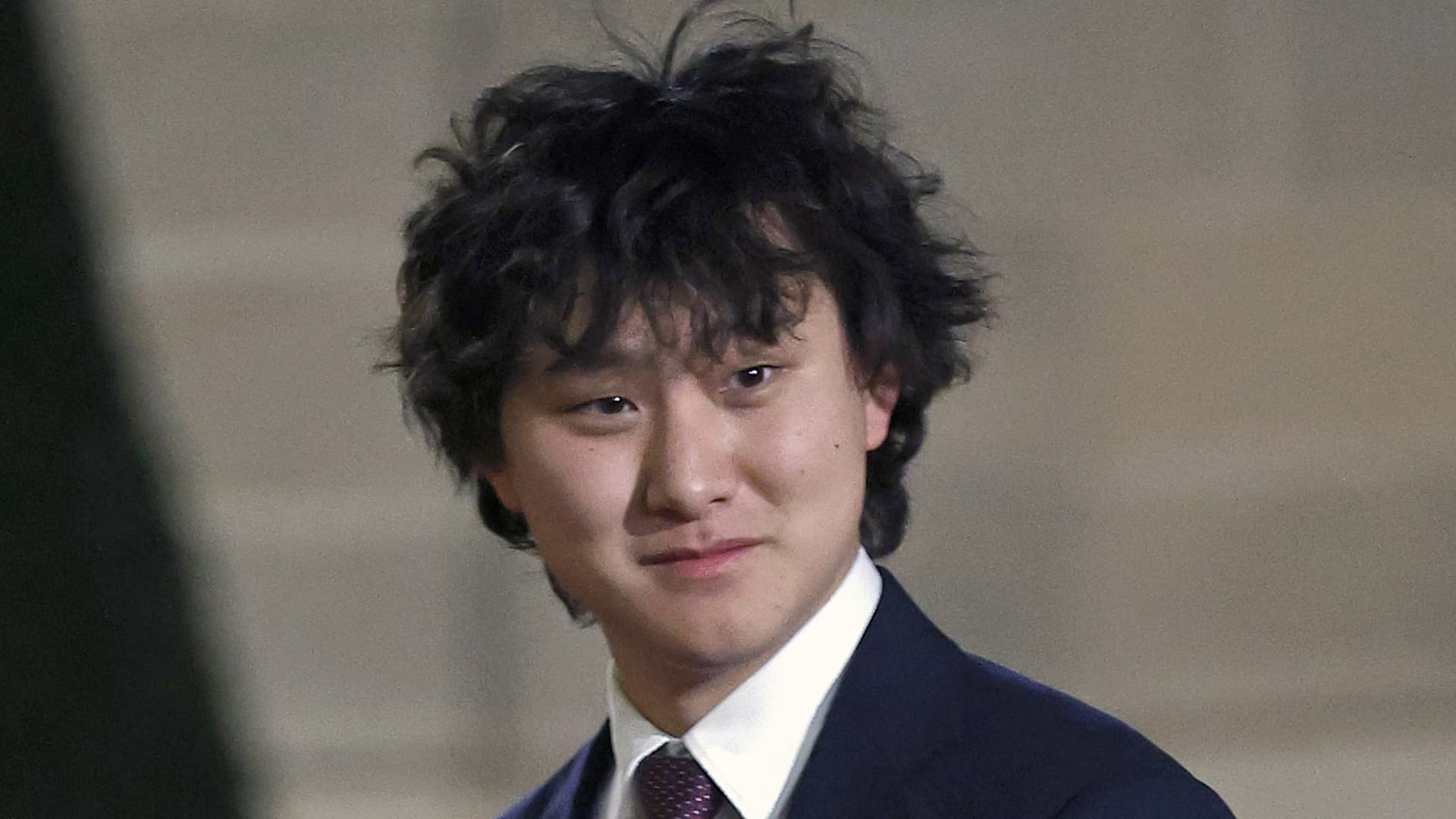
Alexandr Wang, former CEO of Scale, attends an AI summit in Paris in February 2025.
Getty Images
The founders of some of the world’s most successful startups were young: think Bill Gates or Mark Zuckerberg, both of whom were just 19 when they started their companies.
But with the rise of billion-dollar artificial intelligence (AI) startups, a new trend is emerging: Their founders, on average, seem to be getting younger.
A new report released by global venture capital firm Antler reveals that the age of AI unicorn founders has increased from a peak age of 40 in 2021 to 29 in 2024. Antler analyzed 1,629 unicorns and 3,512 founders globally for this report.
However, in other sectors, the age of founders is increasing. In 2014, the average unicorn founder was 30 years old at launch, compared to 34 years old for those who reached unicorn status between 2022 and 2024.
Several AI startups with young founders have been in the spotlight over the past year. Alexandr Wang, co-founder of Scale AI, a $29 billion AI data labeling company, is only 29 years old. Wang was poached by Meta in June, as part of a $14.3 billion deal with the startup, to lead the tech giant’s new AI research unit, called TBD Labs.
In fact, Meta’s former generative AI team, led by 65-year-old AI godfather Yann LeCun, was reorganized after its LLama4 AI model didn’t perform well.
This saw Wang become LeCun’s manager and signaled Zuckerberg’s desire to bring in a more scrappy, entrepreneurial head of AI, so Meta could move more quickly in the AI space.
Meanwhile, Mercor, an AI-powered recruiting and talent platform, was also co-founded by Brendan Foody, Adarsh Hiremath and Surya Midha, all currently 22 years old. It was recently valued at over $10 billion.
AnySphere, an AI-powered coding and development platform valued at over $1 billion, is also run by twenty-somethings.
Fridtjof Berge, co-founder and chief commercial officer of Antler, told CNBC Make It that the founders’ key qualities have evolved into the ability to “move fast and break things,” and to “continuously iterate, test and improve.”
Berge said, “It’s perhaps even more important now to experiment…while other things that are still important but less important now are having been in an industry for a long time or learning the textbooks for traditionally thinking about growing a new business.”
Corporate experience “matters less”
Fridtjof explained that expectations of industrial experience in founders are now seen as less essential than being scrappy and entrepreneurial.
“I think when you think about it, the willingness and ability to experiment in the AI era probably counts as more important than traditional corporate experience or company tenure,” he said.
Fridjtoff added that it “matters less” to have a lot of experience building traditional businesses and that this can, in fact, backfire. “You can’t think from scratch,” he said.
“I think to be technically proficient in many of the latest and greatest technologies, sometimes it helps to be young, because that’s what you’ve learned recently in your education,” he added.
In fact, Antler’s report reveals that AI startups actually scale two years faster than all other industries, reaching unicorn status in 4.7 years on average. Examples of fast-growing AI startups in 2025 were Mistral, Lovable and Suno AI.
And as Zuckerberg’s example proves, implementing a crazy idea in a college dorm can lead to phenomenal success.
“He was extremely young and definitely adapted, adjusted and is now the head of one of the biggest companies in the world,” Berge said.
Venture capital firm Leonis released its Leonis AI 100 report in November and also found that AI startup founders had a median age of 29 at founding. Most founders are between 25 and 35 years old and often come directly from academia or research labs rather than a corporate career.
Berge noted that while 20-somethings possess qualities that allow companies to scale quickly, leadership can often change hands as the company grows.
“I guess it’s nothing new that young people or young founders are starting companies… but that doesn’t guarantee that everyone who creates unicorns today will be the ones running these companies in five to 10 years,” he added.