

A new era at Manchester United has started with a bang.
Michael Carrick’s tenure as head coach may only last until the end of the season, but he made an immediate impression at Old Trafford, leading his side to a deserved 2-0 victory over Manchester City.
It is a result which has significant implications in the Premier League title race, with City missing the opportunity to put pressure on Arsenal ahead of the league leaders’ trip to Nottingham Forest later today, and boosting United’s hopes of Champions League qualification.
We break down the main talking points.
How good were United?
Michael Carrick only started work with the Manchester United squad on Wednesday, but his team approached this match with a structure, style and purpose rarely seen in a difficult 2025.
Derbies can have a clarifying effect on this team. There was none of the uncertainty and frustration that can seep into games where United are expected to dominate possession and break down a stubborn backline. The Old Trafford crowd were swept away by the home side’s impressive defensive work rate. When United lost the ball, they came back to protect the back four. Casemiro, Harry Maguire, Lisandro Martinez and others did not hesitate to dig into the ground to make sliding tackles and block City’s shot.

Michael Carrick celebrates his first victory (Carl Recine/Getty Images)
And when it was time to attack, United did so brilliantly. In 2020, Ole Gunnar Solskjaer explained that United’s forwards had to be prepared to “break their noses” to score goals. In tense matches between the biggest teams, the work you do without the ball can be just as important as your touches with it. Thus came United’s second goal, Patrick Dorgu breaking through his stomach to beat Rico Lewis in the penalty area before adding the finishing touch to Matheus Cunha’s cross.
It was a hard-won United performance, with several players deciding to be brave and put a foot forward, when in previous weeks they might have taken a step back.
Carl Anka
What went wrong for City?
City were not at their best, largely due to the pressure United put on them and the atmosphere generated inside Old Trafford.
Pep Guardiola’s men tried everything they could to calm things down by putting Bernardo Silva and Rodri on the ball and pressing Rico Lewis inside to help, but this was not a game they could keep quiet.
In the first half, Rodri looked in turmoil, giving United their best chance of the game so far by ceding possession with an uncharacteristically sloppy pass – it even looked like he wasn’t enjoying the space around him, which you wouldn’t expect, although he improved after half-time.
The other problem City had throughout the game was that even during the periods when they could make United sit, the visitors’ use of the ball in the area was very poor and there seemed to be little hope of scoring a goal against the run of play.
Sam Lee
How important was Haaland’s replacement?
If Erling Haaland is ever sent off, the talking point is usually whether the decision robbed him of the chance to score a hat-trick, because you can be sure that if he is rested, then City are convinced the game has been put to bed.
It was exactly the opposite: with Guardiola bringing on Rayan Ait-Nouri, Divine Mukasa and Tijjani Reijnders for Jeremy Doku, Bernardo Silva and Haaland in the 80th minute, it was essentially the waving of a white flag, even though Haaland managed just 15 touches throughout the match.

Pep Guardiola replaces Erling Haaland (Michael Regan/Getty Images)
Guardiola, like many coaches, is hyper-aware of the signals that substitutions can send to players on the pitch – a good example is his reluctance to bring forward attacking options in tight games where he is quite happy with the ‘safe’ nature of the game, even though City are hardly threatening.

It’s something that can be difficult for outsiders to understand, but the message at midday on Saturday was clear: this match cannot be saved.
Sam Lee
How did United come to be and why did it cause problems for City?
Modern Manchester derbies have generally followed a particular rhythm. Pep Guardiola will ask his team to slowly suffocate United with a million passes, while United’s head coaches (permanent five) will look to contain and counter-attack.
Michael Carrick has 17 games to secure Champions League qualification and allowed United to settle into their old routines in his first 45 minutes. He set up a 4-2-3-1 with Bryan Mbeumo at the tip of the spear. Out of possession it became a 4-4-2 involving Bruno Fernandes signaling when he thought it best to press high or let go. An attacking approach saw Diogo Dalot and Amad Diallo frequently look to run in behind on the right side, while Lisandro Martinez looked to make long passes into space.
United finished the first half with 28% possession. Carrick didn’t want his men to pass for the sake of passing, but to try and penetrate an uncertain City back line as much as possible.
And it worked: compact and organized when they had to be on defense, quick and aggressive up front. The only thing missing was the first goal. Harry Maguire went close inside the opening five minutes, his header from a corner crashing into the woodwork.
Amad Diallo had a goal disallowed for a reasonably clear offside…

… Before Fernandes was denied by a much closer call, thinking he had timed his run perfectly.

United built on their strong first-half performance in the second half, when their goals finally arrived, but the foundations were laid in those opening 45 minutes.
One game is too early to tell if Carrick has alleviated United’s biggest woes. But it was a great start.
Carl Anka
Was Dalot lucky to avoid a red card?
Referee Anthony Taylor was presented with a nightmare scenario after 11 minutes. Manchester United right-back Diogo Dalot arrived late to try to tackle Jeremy Doku, who had moved the ball with quick footwork.

Diogo Dalot’s high tackle on Jeremy Doku only received a warning (Sky Sports)
He caught the little Belgian “high, (grazing his studs) across the kneecap”, according to former Premier League referee Mike Dean on Sky Sports. Dean warned that “at normal speed you can’t tell. The replays aren’t good” and felt he was lucky to avoid a red card.
Dalot was given a yellow, which VAR concurred with, meaning United kept their 11 on the pitch. Luke Shaw, United’s other full-back, was booked six minutes later, putting them in a precarious position against one-on-one specialists Doku and Antoine Semenyo.
This was partly why United fell into a 5-4-1 at times, with right winger Amad coming in to act as a winger and defend Doku, meaning Dalot did not have to risk a second yellow card.
Liam Tharme
Did Bruno’s change spark United?
And to think that Ruben Amorim played Bruno Fernandes in number 6.
Fine, United’s former head coach kept trying to fit summer signings Matheus Cunha and Bryan Mbeumo into that damn 3-4-3 system, but whoever runs this team should still build their team around Fernandes.
This game suited the Portugal international, with United playing straight on the break, meaning he could showcase that vast range of passing to pace: Mbeumo, Amad, Dorgu.

The technical brilliance in set situations was also there: that corner coming in a few minutes later, where Harry Maguire headed against the bar, the cross to the back post from the half-space where Mbeumo forced a powerful save from Gianluigi Donnarumma.
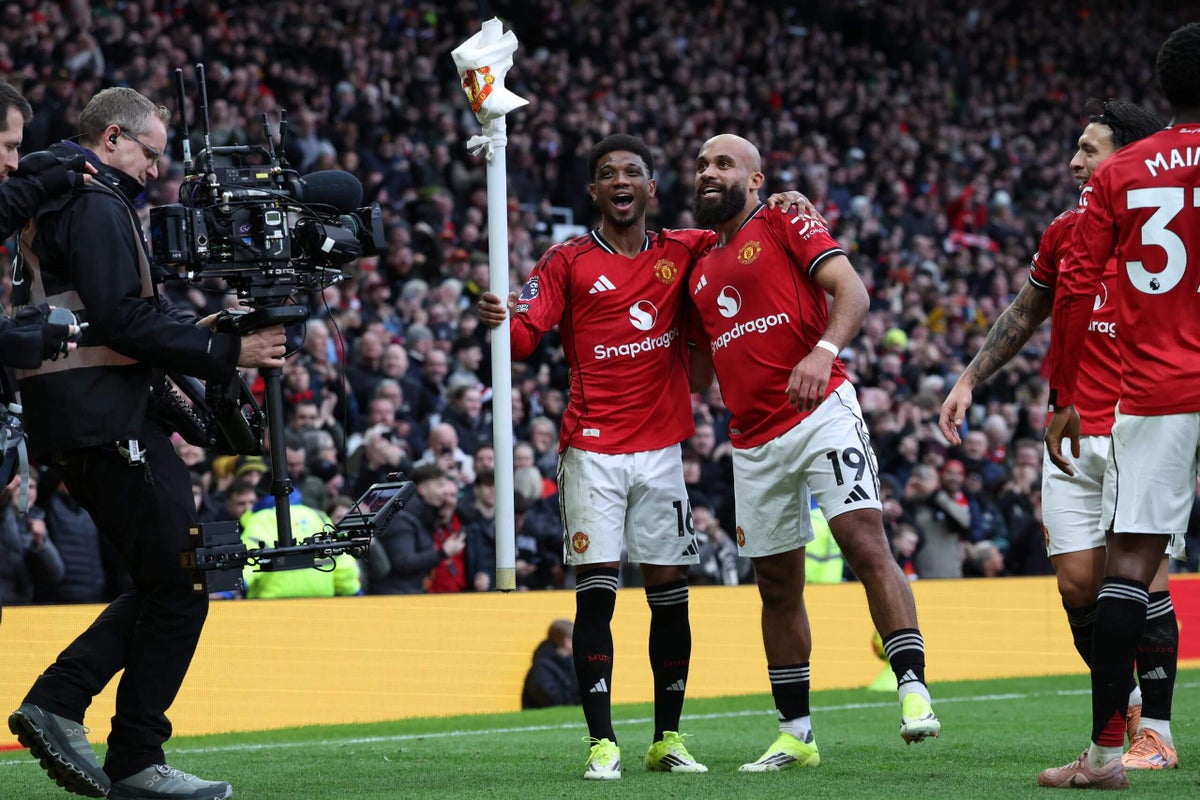
When he allowed Mbeumo to open the scoring on the break – perfectly weighting the pass on a four-on-two breakaway so that Mbeumo could finish on his dominant left foot – it was a deserved United goal and an assist from Fernandes.
He himself had broken the offside trap in the first half with a run behind and put the ball in the back of the net, only for the flag to go up.
Fernandes has assisted in three consecutive games since Amorim’s departure. He breaks the lines and creates chances (three big chances today). That’s why you play him number 10.
Liam Tharme
What future for United?
Sunday January 25: Arsenal (away), Premier League, 4:30 p.m. UK, 11:30 a.m. ET
What future for City?
Tuesday January 20: Bodo/Glimt (away), Champions League, 8 p.m. UK, 3 p.m. ET
Source | domain www.nytimes.com