

Around 1972, Walter Steding hitchhiked to New York from his hometown of Harmony, Pennsylvania. He was 21, armed with two sack lunches packed by his mother and a two-year degree from a commercial art school. In Manhattan, he moved into an old closet near Union Square. (It came with a sink.)
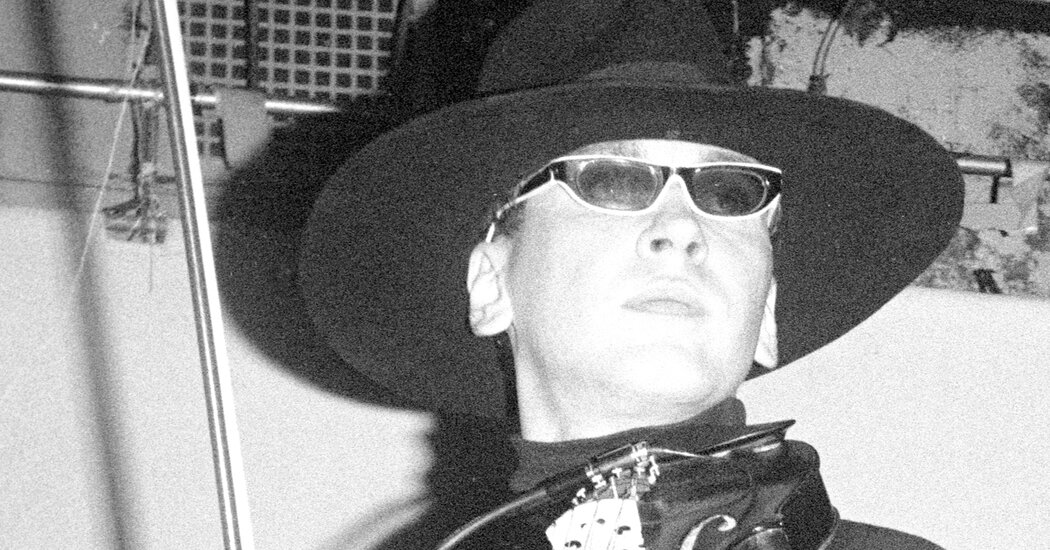
He was interested in the “aesthetics of sound,” as he put it, and had experimented with an electric violin, a synthesizer he built himself, and an EEG machine, which measured his brain waves. With this equipment and no musical training, he transformed himself into a supernatural one-man band.
He began performing at various events at galleries around the city, using his violin to make strange, whistling sounds, while wearing a biofeedback device strapped to his belt and a pair of flashing glasses that he claimed were synchronized with his brain waves.
For many years he performed at avant-garde festivals organized by Charlotte Moorman, who played cello topless. He also played with a band called Ether Ship, whose members he had met at art school and who were interested in extraterrestrial languages and space travel.
But even among this crowd, his sonic adventures made him an exception.
Andy Warhol was so charmed by Mr. Steding’s bizarre act that he decided to direct him – the first and only act Warhol directed after the Velvet Underground. And he helped Mr. Steding by giving him odd jobs in his factory: stretching canvases, mixing paint and chatting with guests like Keith Richards and Georgia O’Keeffe, who came to lunch before being photographed for Mr. Warhol’s Interview magazine.
Mr. Steding was also a talented painter whose distorted portraits were reminiscent of the work of John Currin and Fernando Botero, and he began painting visitors to the factory as they came and went. Yet despite Warhol’s imprimatur, he maintained a life and artistic practice on the margins.
To create a cliché, he was one of the most remarkable avant-garde artists you may never have heard of.
Mr. Steding died in mid-November at his apartment in Greenpoint, Brooklyn, days before performing at a memorial service for Marcia Resnick, a photographer of New York’s downtown demimonde, at the Cooper Union in Manhattan. He was 75 years old. The cause of death, which was not widely reported at the time, is not yet known, said his daughter, Georgeanna Tisdale Steding.
In the late 1970s and early 1980s, Mr. Steding was omnipresent, exhibiting at galleries like White Columns and performing at clubs like CBGB, the Ritz and the Mudd Club. He was the conductor of Glenn O’Brien’s “TV Party,” the anarchic cable television talk show available to the public in New York, first broadcast in 1978 and featuring a group of Mr. O’Brien’s friends, including Jean-Michel Basquiat, then an unknown young graffiti artist; Fab 5 Freddy, the hip-hop pioneer; and Chris Stein and Debbie Harry of Blondie.
In a 2005 documentary about the show, Mr. Stein noted that Mr. Steding’s music, like the show itself, “was a little incoherent at times — there was a lot of droning, sort of psychedelic passages.”
Ms. Harry added: “He kind of has his own sense of structure when it comes to music. He doesn’t seem inhibited or, you know, coming from a position of overtraining.”
In the summer of 1979, when Mr. Steding opened for Blondie at Central Park’s Wollman Rink, he confused at least one critic in the audience.
“Its bizarre blend of melodramatic theater and pulsating rhythm seemed to amuse the crowd,” John Rockwell of The New York Times wrote in his review of the show. “But the reaction could have turned hostile if he hadn’t reined in after 15 minutes.”
Even so, Mr. Warhol was determined to make Mr. Steding a New Wave pop star. He helped him record two albums, produced by Mr. Stein, and two music videos, produced by Vincent Fremont, then a vice president of Andy Warhol Enterprises. Seen now, they’re poignant artifacts of the awkwardly lo-fi early MTV era.
One of the songs, “Secret Spy,” was filmed on the now-demolished West Side Highway piers in Manhattan. Mr. Steding is dressed in black clothes and a terrific black fedora, and is accompanied by a few bandmates preening in early ’80s drag style, all with big hair and short skirts. He performs a seductive tune on his violin that is rather more coherent than his usual atonal fare.
“We worked hard,” said Mr. Fremont, who did most of the work. management work of Mr. Steding, said. “But we didn’t get any traction.”
Of Mr. Steding, he added: “Andy really believed in himself, and he didn’t lend his name to just anyone. There was an innocence to Walter and a mischief that was attractive. He just thought in a different way from everyone else and didn’t know how to promote himself consistently.”
Mr. Steding was a free spirit, Ms. Harry noted in the documentary “TV Party” — “a practicing free spirit.”
Walter George Steding was born September 7, 1950, in Pittsburgh, the second of four children of George and Gloria (Irwin) Steding. His father was a mechanic.
The family moved to Harmony, a small rural neighborhood north of the city, when Walter was 8 years old. He then attended the Ivy School of Professional Art in Pittsburgh, a commercial arts school, where Keith Haring studied for a time. (It closed in 1980.)
In New York, Mr. Steding nestled lightly, at first shuttling between his closet and his girlfriends’ apartments. He lived for a time in a loft owned by Mr. Warhol on Great Jones Street, until Mr. Basquiat moved in. He then stayed with Mr. Stein at Mr. Stein’s loft in TriBeCa and went couch surfing with other friends. Twenty years ago, when Mr. Stein moved upstate, Mr. Steding took over the lease on his newest apartment, in Greenpoint.
He supported himself by painting portraits, which numbered in the hundreds. Taken together, they constitute a compelling document of Manhattan’s underground creative class of the Warhol era. When Mr. Steding was really in trouble, friends like Mr. Fremont and Mr. O’Brien, who had already helped him by commissioning portraits of their families, would ask Mr. Steding to paint their dogs, which he rendered with the same eerie acuity and touch of menace that he brought to his human portraits.
In addition to his daughter, from a relationship with Elizabeth Tisdale, an artist, Mr. Steding is survived by his siblings, Bonnie Beckey and James and Raymond Steding.
When Mr. Steding first arrived in Manhattan, he found a cache of letters written by a 19th-century ship captain that had been stored in crates and then left on a sidewalk near the factory. The letters sparked something in him and he began researching the maritime trade routes of the time and the merchants who made their fortunes through them. He continued to collect ephemera from this era for the rest of his life and paid tribute to the captain with a song “Captain Henry” and a portrait.
In May 2025, Mr. Steding began a residency with Silver Art Projects, an organization that provides visual artists with studio space for a year on the 28th floor of 4 World Trade Center in Lower Manhattan.
There, he planned to build a cardboard model of a ship called America, a merchant vessel that had been converted into a privateer during the War of 1812. It was not Captain Henry’s ship, but it was similar and it had an exciting history.
Gregory Thornbury, executive director of Silver Art, said the work “was going to be an elegy to the lost promise of America, the country, and how it went from a place of freedom to a nation of corporate pirates — so there was an element of anti-capitalism in it.” »
At least, that was what he thought Mr. Steding was looking for, he said.
Voluble and prone to digressions, Mr. Steding had not precisely articulated his vision. His studio remains as he left it, strewn with notes, photocopies of his paintings, a sketch of a frigate and other naval objects.
“It was like a return to another era,” Mr. Stein said this week. “Adrift in modern society, but still comfortable.” »
Source | domain www.nytimes.com