

This week, Instagram became a time machine. As I scrolled through my feed, I was struck by the feeling of having traveled back a decade. Instead of the usual fare — mostly content from influencers and ads — I was greeted with hundreds of old photos of friends and celebrities revisiting life in 2016.
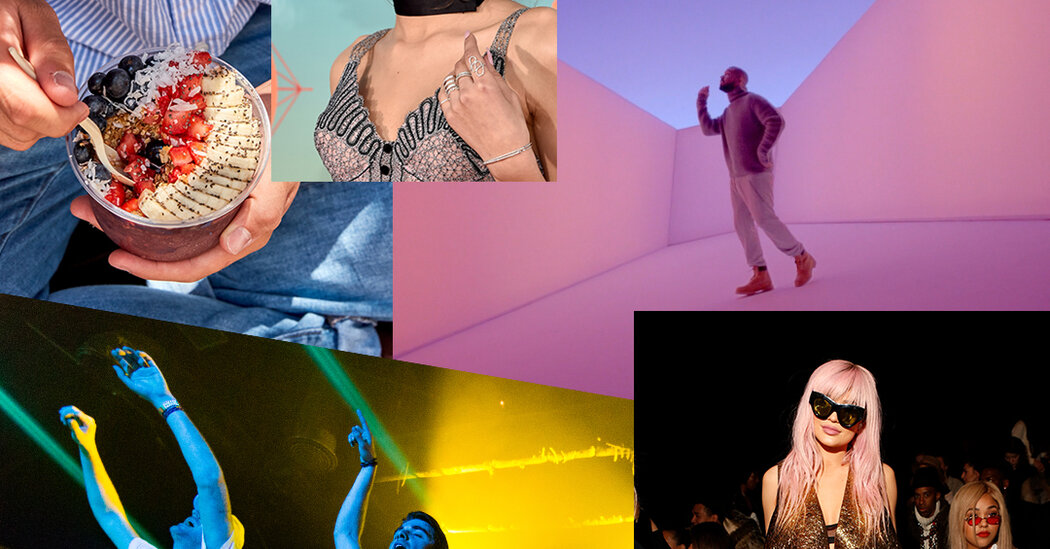
Hyper-filtered, grainy images of acai bowls and sunsets. Skinny jeans, black chokers, and Snapchat filters that put flower crowns and dog noses on our faces. It was the era of short-form video apps Vine, Pokémon Go, and Kylie Jenner lip kits.
Without even realizing it, I found myself humming “Hotline Bling” by Drake.
“You just had to be there,” Ms. Jenner wrote on Instagram this week alongside a photo of herself with pastel pink hair and a Supreme sweatshirt. Writer Lena Dunham, actress Selena Gomez and model Karlie Kloss have all posted similar throwbacks – which, in 2016, might have been accompanied by the hashtag #TBT.
Looking to the not-so-distant past is the latest example of the acceleration of nostalgia online, where trends and subcultures can shine and die quickly, making the landscape of just a few years ago feel like a foreign country. The current yearning for 2016 also fits into a recent cultural obsession with so-called millennial optimism, the presumed mindset of those who came of age in the 2010s, when indie music ruled, social media platforms like Instagram and Twitter were novelties, and the words “novel coronavirus” were a gleam in anyone’s eye.
It’s a powerful attitude among millennials themselves, but also among Generation Z, who remember little of the era or have reached the end of it – and whom some older generations accuse of having too rosy a vision.
Camrie Farran, a 25-year-old nanny in Kansas City, Kansas, remembers feeling at that time that she and her peers had the world “at their fingertips.” A high school freshman in 2016, Ms. Farran identifies as a “zillennial,” a micro-generation that falls between Generation Z and millennials, she added.
This week, she posted a series of old photos on TikTok, flash-lit selfies in school bathrooms, pseudo-artistic nature photos, and a black-and-white photo of her and her friends’ Converse sneakers.
The sudden influx of people posting old content seemed like an attempt to “romanticize life again,” she said, adding that the pandemic had warped her sense of time and made her nostalgic more quickly. “It’s only been 10 years, but for me, 2016 feels like a whole different lifetime.”
“There wasn’t that much pressure,” she added. “You didn’t feel like all eyes in the world were looking at you. You could just post whatever you wanted. You didn’t worry about likes.”
Kate Kennedy, author of “One in a Millennial: On Friendship, Feelings, Fangirls and Fitting In,” says the 2016 resurgence has in part to do with how social media platforms have evolved over the past decade.
“On the surface, it looks like a celebration of fashion and music: we were listening to the Chainsmokers and our shirts had neckbands built into them,” Ms. Kennedy said. “But I think it really has more to do with the fact that 2016 sits at the intersection of nostalgia and structural changes we didn’t know existed on the internet.”
In 2016, Instagram changed the way users viewed content by testing a non-chronological feed. Instead of seeing a stream of photos in the order they were posted, Instagram users began seeing content curated by algorithms, with an invisible hand now choosing which images to feed users.
Users initially complained, but this way of consuming content quickly became the norm, not only on Instagram but also on platforms like TikTok, where a hyper-curated algorithm became the app’s addictive secret sauce.
“Timeline feeds were like democracies: every post had an equal chance of being seen,” Ms. Kennedy said. “An algorithmic feed decides what you see based on your intended engagement. It doesn’t respond to your true interest. It’s about keeping you on the app as long as possible.”
Over time, this also means meeting fewer people you actually know. This week was a quick reminder of the familiar faces that once filled our feeds.
Even with a VSCO filter overlaid, to some, these images looked more real than their current counterparts, which can be manipulated by artificial intelligence – or tricked enough to look like it – or posted purely for marketing purposes.
.
Are people really missing 2016, a year that, like every year, had no shortage of hardship and despair for many people around the world? Or are we just missing an Internet that no longer exists?
Top grid: photographs by Mike Coppola/Getty Images; Emily Berl for the New York Times; Archives of the Republic; Elizabeth Lippman for The New York Times; The New York Times; Christopher Polk/Getty Images; Jason Varney for The New York Times; Alberto E. Rodriguez/Getty Images
Source | domain www.nytimes.com